バイオセンシングの新たな可能性
Explore why diode lasers represent a critical technology for supporting the rapid emergence of next-generation wearable health monitors.
2023年9月20日 著者: Coherent

家電製品の主なトレンドの一つは、個人の健康状態をモニタリングするスマートウォッチやその他のウェアラブルデバイスの進化である。当初は心拍数のモニタリングから始まったが、現在では心拍変動(ストレス)、血圧、血中酸素濃度のモニタリング機能も備えるものが多くなっている。さらに、水分補給状態や乳酸値を測定して筋肉の疲労度を評価できるデバイスも開発が進められている。また、完全に非侵襲的な血糖値モニターが間もなく登場し、糖尿病患者の生活の質を向上させるとの予測もある。
これは一体どういうことでしょうか?健康モニタリング機能の強化には、2つの要因があります:
第一に、健康管理において予防・維持的なアプローチを求める声があります。これは、重大な症状が現れるはるか以前に、潜在的な問題を早期に発見し、対処するというものです。
第二に、バイオセンシングデバイスは、例えば慢性疾患の管理などにおいて、より個別化された医療ソリューションを実施するために必要な情報を医師や患者に提供するという点で、重要な役割を果たすことができます。
Why Diode Lasers
技術的な観点から見ると、モニタリング用アプリケーションはすべて、何らかの光学センシング技術を採用しています。前述の乳酸、血糖、水分補給状況のモニタリングといった、新しくより高度なアプリケーションはすべて、レーザー光源の特殊な特性を利用した光学技術に依存しています。
What kind of laser? Lasers vary tremendously in terms of power, wavelength, size, cost, pulsing characteristics, and other parameters. (We know because we make just about every kind of laser at Coherent!).
ウェアラブル健康モニター(あるいは一般的な民生用電子機器)のような用途においては、満たすべき4つの重要なレーザー要件があります:
低コスト
コンパクトで軽量なサイズ
低消費電力
信頼性
Diode lasers (often called laser diodes) are the only lasers that can meet all of these requirements.
ウェアラブル端末の現在および将来の活用例:
心拍数のモニタリング
血中酸素濃度のモニタリング
水分補給のモニタリング
血糖値のモニタリング
乳酸モニタリング
疾患の検出と個別化医療
VCSELのロードマップは民生用アプリケーションが主流
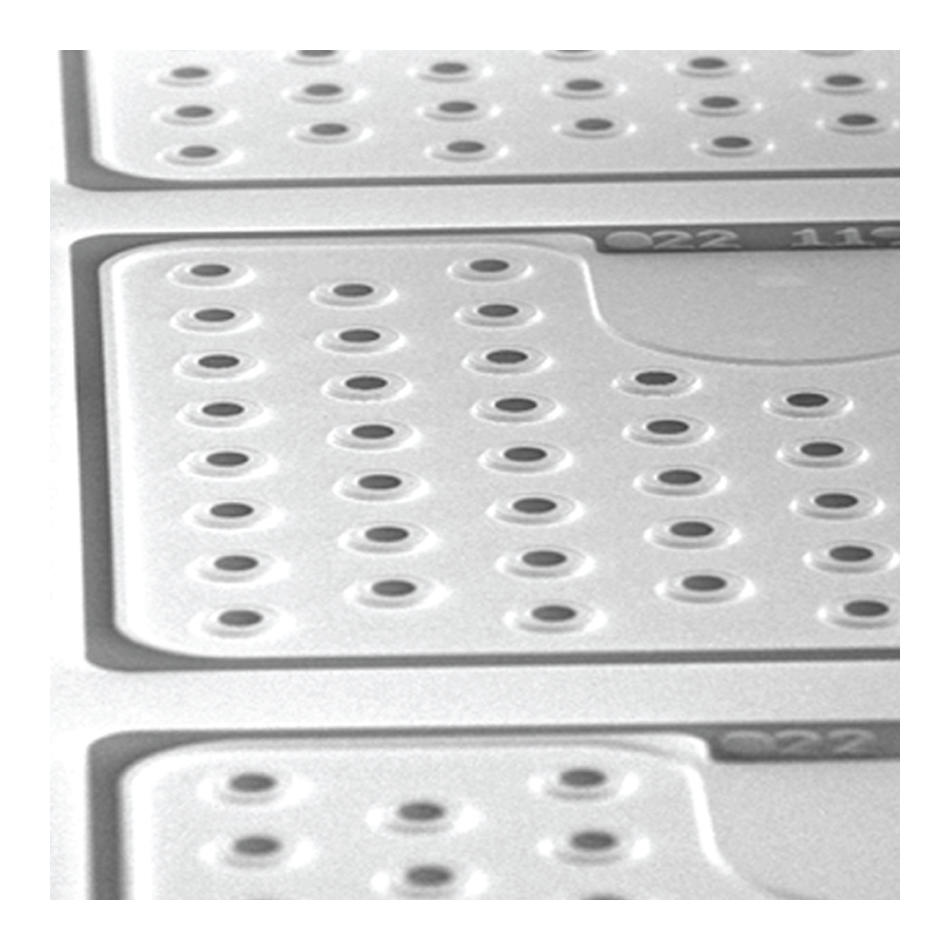
Diode lasers come in many different varieties and are available over a wide wavelength range. As of today, the most popular type of diode laser for most optical sensing applications is the VCSEL (pronounced “vixel”).
A key advantage of a VCSEL over other diode lasers is that it emits light from the top surface. VCSELs are available in the near-infrared (NIR) range from 750 nm to 1200 nm and deliver a circular beam of light that doesn’t require sophisticated optics. This characteristic makes integration easy and minimizes the total weight and cost in many applications.
こうした利点から、VCSELは民生用電子機器のさまざまな用途で広く利用されています。その用途は、光学式マウスのナビゲーションやゲーム機のボディトラッキングから、スマートフォンやタブレット端末に搭載される近接センサーや顔認識センサー、3Dスキャナーにまで及びます。また、自動運転を実現するための自動車用センシング用途や、運転者および乗客のモニタリング用途にも活用されています。さらに、VCSELは脳イメージング(fNIRS)の分野でも利用され始めています。
ちなみに、VCSELはデータセンターの光通信分野でも広く利用されています。VCSELの高速変調能力、実装の容易さ、そして優れたコストパフォーマンスは、極めて高い帯域幅を必要とする短距離データリンクに最適であり、これはまさに、人工知能(AI)アプリケーションの爆発的な成長を支えるためにデータセンターが求めているものです。
At present however, the largest single application for diode lasers is in smartphones for facial recognition, which uses two VSCEL arrays emitting infrared light at 940 nm. How big? Well Coherent has already supplied over 200 billion VCSEL emitters into consumer electronics applications. This was possible because we have made significant investments in VCSEL manufacturing, built and brought online new fabs, and scaled production from 75 mm to 150 mm wafers. In fact, today we are the world's largest vertically integrated manufacturer of VCSELs using mature processes with correspondingly high yields and economic products.
Besides VCSELs, Coherent also manufactures another type of laser diode: the edge emitting laser (EEL). This type of laser emits light from the side of the chip with a slightly elliptical beam shape. The main advantage of edge emitting laser is that their architecture is compatible with different materials systems that enable different wavelength ranges. We make EELs based on gallium-arsenide, indium-phosphide, as well as gallium-antimonide and cover the wavelength range from near-infrared (NIR) at 750 nm up, over short-wave infrared (SWIR) into the mid-infrared (MIR) up to 3000 nm. The longer wavelength ranges (SWIR and MIR) are particularly relevant for bio-sensing applications, because this is where light interacts with bio-molecules present in the human body. Edge-emitters are also manufactured in high volumes and used in consumer electronic devices, although not quite as widely as VCSELs. A well-known application is in smartphones, where edge emitters enable the most advanced proximity sensors.
統合サプライヤーによる統合ソリューション(PIC)
While a diode laser such as a VCSEL is the light source that will power many wearable medical sensing devices, it’s only a part of a complete photonic sensing system. Other key components include photodetectors (photodiodes) and gain chips such as semiconductor optical amplifiers (SOAs).
Coherent 垂直統合型のフォトニクスメーカーCoherent 、これらの主要コンポーネントの大手サプライヤーです。当社は、フォトニクス分野の他の関係者と共同で、将来のアプリケーションにおいては、システムレベルでコンポーネントを統合し、ウェアラブル電子機器に求められる小型化を実現するために、フォトニック集積回路(PIC)への依存度が高まると考えています。PICは、エレクトロニクス分野を席巻しているICに相当するフォトニクス技術です。
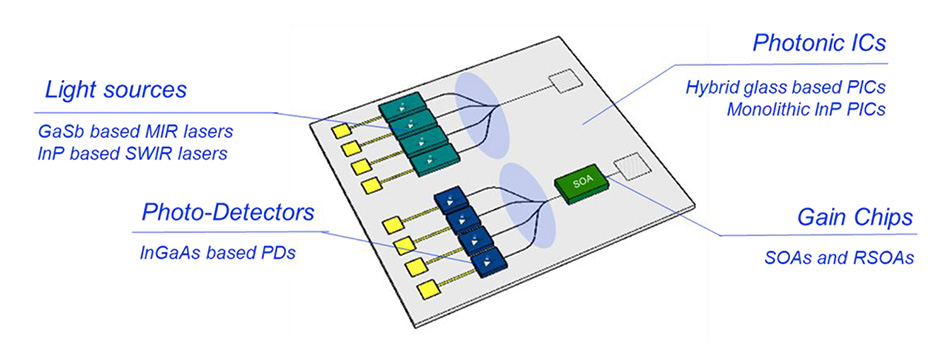
Coherent 、光通信用途でもPICを採用しているため、このトレンドを支援する上で有利なCoherent 。
バイオセンシングの未来がここに
To summarize, new bio-sensing functions will be added to wearable devices. Many of the new functions rely on optical sensing using diode laser light sources.
Coherent is already well positioned to support these applications as a vertically integrated manufacturer of diode lasers already supplying large volumes of both EELs and VCSELS to the consumer electronics industry. Moreover, our portfolio and expertise include the complementary technologies needed to make bio-sensors, such as photodiodes, gain chips, and photonic integrated circuits.